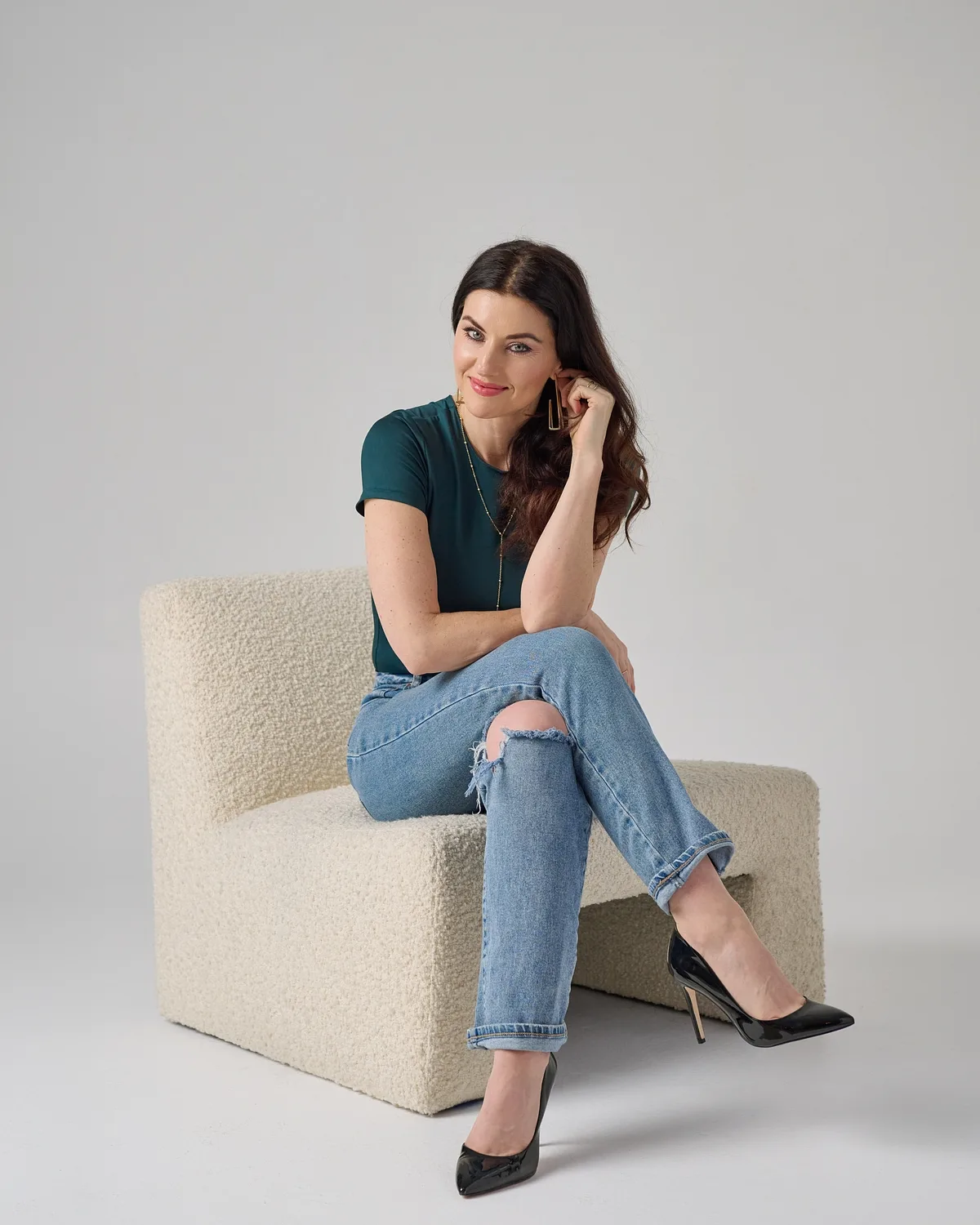
Lacey Johnson
MA, AMFT
Trauma Therapist and Writer
We ask every featured student a set of in-depth questions about their clinical experience, their path to neuronutrition, and what the program has meant for their work. Our goal is to give others an honest, unfiltered look at what practicing in this space actually looks like, and showcase the impact that our students are having in their communities.
Lacey Johnson is a trauma therapist, writer, and founder of Power Haven Therapy. Before earning her master's degree in Marriage and Family Therapy, she spent more than a decade as a nationally recognized journalist specializing in mental health and relationships, with work appearing in Oprah Daily, Marie Claire, Cosmopolitan, and Apple News. She interviewed leading voices including Deepak Chopra, Gabby Bernstein, neuroscientist Dr. Caroline Leaf, and psychologist Dr. Shefali Tsabary. Today, Lacey integrates evidence-based modalities — including IFS, Restoration Therapy, the Gottman Method, and Brainspotting — with a deep respect for the nervous system's role in healing. You can follow her work on Instagram and visit her practice at powerhaventherapy.com.
What led you to transition from a nationally recognized career in journalism into becoming a trauma therapist, and what did you feel called to do differently through clinical work?
I no longer wanted to stop at illuminating the nuances of healing and transformation; I wanted to midwife it. Another way of describing the charge behind that decision is to say that being a journalist, and staying one, began to feel uncomfortable. For example, sometimes I'd be in an interview with a feature subject, digging at the content of their story, when I'd notice a pattern or a process that I felt compelled to name or pull into the light for greater examination. Except that wasn't my job.
Once, a feature subject chuckled near the end of an interview, saying, "That was like therapy, actually." I remember thinking, "Yeah, maybe in another life." Then, after several of my most trusted story sources — psychologists, neuroscientists, therapists — began to pause and say things like, "You know, Lacey, you're like a therapist…" I realized I was being called to evolve. "Maybe in another life" was rewritten to say, "No, not another life; this one." It was sort of a painful awakening, because being a writer and a journalist was so braided into my identity. And, yet, it was one of the most honest, intelligent, and soul-led decisions I've ever made.
Your work emphasizes helping people become their own secure attachment figure and build nervous system safety. How do you imagine nutrition fitting into that larger process of healing and self-trust?
Food is such a profoundly emotional, and socio-emotional, part of our lives. We build systems of rituals around food — some that are centered in bonding, care, celebration, nourishment, and beyond, and some centered in indulgence, restriction, or punishment. Adults with C-PTSD, who did not have healthy attachment experiences early in life, often find themselves struggling to follow their body's hunger cues and self-regulate their emotions.
When I'm working on healing attachment injuries with a client, I occasionally assign them a weekly ritual I call "Eat for your soul." There's so much research in neuroscience and neuropsychology about how eating certain foods — particularly ones we hold safe emotional attachments to from early in life — can unlock deep, unconscious memories in a potently illuminating way. When we bring our powerful, wise adult self to the ritual, it can be wonderfully healing. I ask that any performative part, perfectionistic part, or shaming part not take the lead but, instead, be observers of the experience. The ritual serves as evidence of their ability to care for themselves and become their own safe primary attachment figure, and, perhaps, compassionately and lovingly satiate the parts of them that might have been starving for a really long time.
For the kinds of clients you work with — people who are high-capacity yet internally struggling — what difference do you hope neuronutrition will make in how they understand their bodies and their healing journey?
Not long ago, a client confessed in session that she couldn't recall the last time she'd eaten a meal without standing, neck bent over her laptop screen. She also described managing multiple high-performing sales teams by day, then staring into her refrigerator by night — like a child left alone to fend for their dinner for the first time. Through a systemic assessment and Genogram work, I learned that she'd been raised by a single mother who suffered from addiction and depression, often sleeping through dinner. My client never learned how to care for her health and aliveness; only survive it.
A series of panic attacks led her to my office where she began what is already proving to be a remarkable transformation. One of the first things we've worked on is helping her slow down, reorient, and fully connect to her environment — preparing at least one meal a day with intention and care, tasting and chewing her food, and then putting her hand over her heart and checking in with her body's cues and felt sense. It sounds simple, but it's rebuilding her ability to advocate for, listen to, and trust herself, and it's extending invitations to other arenas of her life, too.
There's a missing link between your clients' nutrition and their brain.
Learn how to address it with the 7-day Neuronutrition Lesson Series.
Looking ahead, how do you hope integrating neuronutrition into your work will change the kinds of conversations people are having about trauma, healing, and the body?
We are each a beautifully interconnected system — a whole human universe. Your emotional self, psychological self, spiritual self, biological self, relational self — they're all uncompromisingly connected and never not influencing one another. When we're working on one aspect of the self, we're working on the whole. And when we're ignoring, neglecting, or punishing one aspect of the self, we're limiting what is true about and possible for the whole.
This is why neuronutrition grabbed me by the collar during my final months of graduate school, pointing me down its mighty path. When we experience traumatic events that deeply wound us, the overtaxed brain and nervous system shift in their nutritional demands, the body is hurled into an inflammatory response, and one's ability to recognize hunger cues can either heighten in a confounding way or go offline completely — something I often see in clients with highly dissociative states. Neuronutrition is an empowering way for one to take back the reins of their well-being, advocating for the brain and nervous system and offering an intentional path toward the brain rewiring itself for greater safety, self-advocacy, and, ultimately, self-love.
What motivated you to join the NANCP program?
A few years ago, during the brief stretch between being accepted into graduate school and starting, I experienced something that confounded me for months — something I would soon come to recognize as parasympathetic withdrawal. Something that unlocked trauma that had been frozen in me for a long time. When I was 6 years old, my family's furniture store business was destroyed by a freak explosion, expiring the lives of my mother, grandmother, and two aunts. I was the only child within our family to witness the fire.
While I was surrounded by loving caregivers in the aftermath, there was no place for mental healthcare in my family's belief system; only faith. But trauma has a way of not letting you just forget. The parts I'd locked away crawled from the basement, so to speak, when my husband admitted the severity of his substance abuse. I was hurled into time travel, feeling the gravity of my original trauma all over again. One of the more disorienting effects was that my body felt like it couldn't be satiated — I was moving through something my body couldn't metabolize.
Even after our home life stabilized, my body's "hidden smoke detector" refused to stop smelling smoke. The stress had completely altered my brain's nutritional demands, and it would take months for my system to reorient, ground, and heal. I folded this conundrum into my professional plans with a sacred promise — that I would continue to be curious about what my body had been trying to tell me, not only in service of myself but in service of all my future clients. One day, Timothy Frie's Instagram account landed in my orbit and I felt a ping that clearly announced, "This way..." And here I am.
How would you describe your experience in the NANCP program so far?
Almost like a trapeze artist, I leapt straight from the semi-prison that is graduate school into private practice — and this program. This is to say, I haven't been able to devote my intellectual energies to it at full capacity. And, yet! I've already folded much of its wisdom into my work with clients. The material is enlivening — even riveting in moments. I feel more in awe of and hold more reverence for my body than I did before starting it. My intention is to model this for my clients.
Is it weird to say that some of the lessons feel like sacred invitations to better understand the body's response to trauma, served with warm cookies and milk? I am often comforted by the material, which has been an unexpectedly pleasant surprise.
There's a missing link between your clients' nutrition and their brain.
Learn how to address it with the 7-day Neuronutrition Lesson Series.